

Have you ever had a nagging pain between your shoulder blades that just won’t go away? You stretch it, you use a lacrosse ball on it, you ask your partner to dig their elbow into that one spot… and yet, two hours later, the ache is back.
It’s frustrating, but here is the clinical secret: the “victim” (the part that hurts) isn’t always the “criminal” (the cause of the problem).
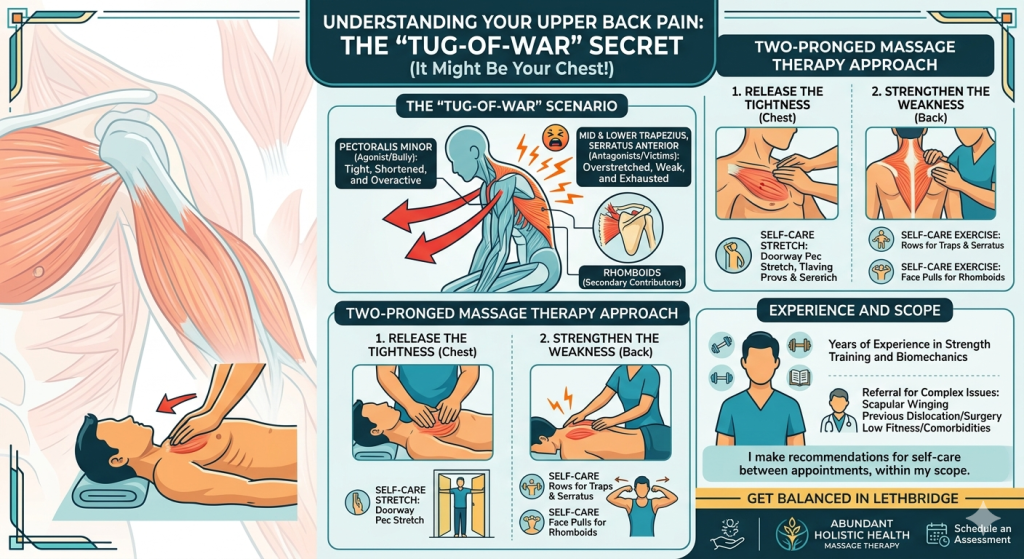
In massage therapy, we look at the relationship between agonists and antagonists. When one muscle (the agonist) is overactive and tight, its partner on the other side (the antagonist) is forced into a stretched, weakened state.
Meet the Bully: The Pectoralis Minor
In our modern world of “Computer Posture,” the primary criminal is often the pectoralis minor. This small but powerful muscle sits under your main chest muscle. When it stays shortened from hours of leaning toward a screen, it pulls your shoulder blade (scapula) forward and down.
While your chest is busy being the “bully,” your back muscles are the “victims” losing the game of tug-of-war. Specifically:
- The Middle and Lower Trapezius & Serratus Anterior: These are your primary antagonists. Their job is to retract and depress the scapula, but they get locked in a “long and weak” position, exhausted from trying to pull you upright against a tight chest.
- The Rhomboids: These act as synergists, helping the traps out, but they eventually fatigue and join the chorus of pain.
The result? That burning ache in your upper back isn’t because those muscles are “tight”—it’s because they are overworked and overstretched.
Beyond the “Rub”: A Two-Pronged Solution
If I only massage your back, you’ll feel great for an hour. But because that pectoralis minor is still short and tight, it will pull your shoulders right back into dysfunction the moment you get in your car.
To fix the feud, we have to address both sides of the body differently:
1. Release the Tension (The Chest)
We use targeted massage techniques to lengthen the pectoralis minor. Once this muscle lets go, the “tug-of-war” rope finally has some slack.
- Home Care: I often recommend a doorway pec stretch to keep this area open between appointments.
2. Wake Up the Weakness (The Back)
Once the chest is released, we need to “turn on” the muscles that have been dragged forward. We soothe the exhausted back muscles to encourage blood flow, but the long-term fix requires strengthening.
- Home Care: I may suggest rows to target the middle/lower traps and serratus, or face pulls to engage the rhomboids.
Why Experience Matters
I’ve been involved in strength training for 30 years. While I might look a bit more “fluffy” these days than in my heavy-lifting prime, my understanding of biomechanics is both academic and personal. I’ve spent decades studying how bodies move—and how they break.
A Note on Scope: While I provide self-care suggestions to support our massage work, I know where the boundaries lie. If your issue is more complex—such as scapular winging, a history of shoulder dislocations, or post-surgical recovery—I will refer you to a Physiotherapist or your GP. My goal is to work with your healthcare team to get you the best result.
Let’s Get You Balanced in Lethbridge
Stop chasing the pain and start addressing the cause. If you are in Lethbridge and ready to stop the “Tug-of-War” happening in your torso, let’s get to work.
Contact Abundant Holistic Health Massage Therapy today to schedule your assessment. Let’s find the root of that ache together!